Off-Page SEO: A Complete Guide
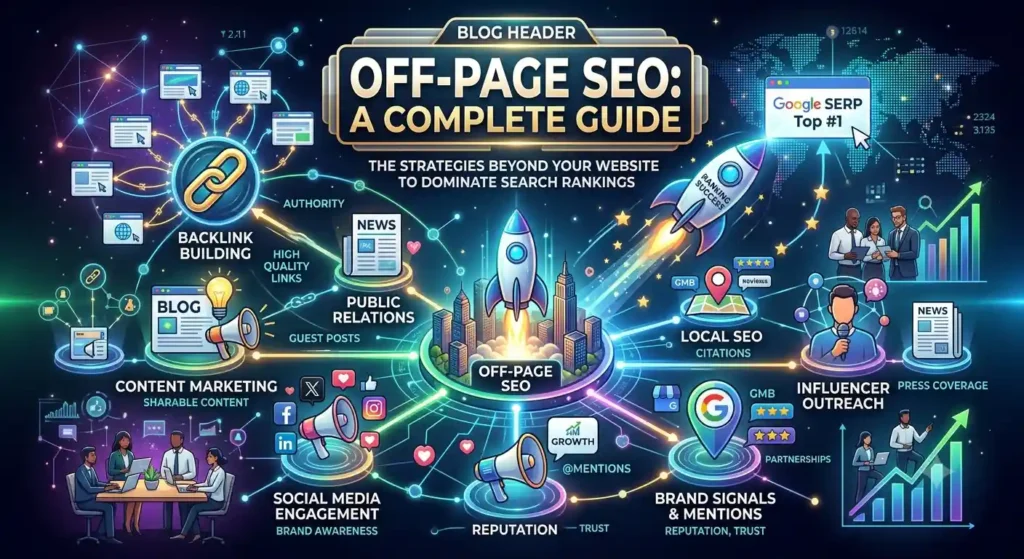
Off-Page SEO: A Complete Guide
You’ve fixed your titles, cleaned up your content and sped up the site. Yet the page still sits on page two. When that happens, the problem often isn’t on your website at all. It’s off-page SEO.
Off-page SEO is everything that happens outside your site to build its reputation with search engines: backlinks, brand mentions, reviews, social sharing and more. This off-page SEO guide explains what counts, what’s a waste of time, and how to start even if your budget is small.
What Is Off-Page SEO?
Off-page SEO means any action taken away from your own website that helps search engines trust it and rank it higher. The biggest piece is backlinks, which are links from other websites pointing to yours. A good link works like a recommendation from someone the search engine already respects.
But links aren’t the whole story. Mentions of your brand, customer reviews, your listings in directories and the way people talk about you online all add to the picture.
Here’s a quick way to separate the two. On-page SEO is what you say about yourself, through content, headings and keywords. Off-page SEO is what everyone else says about you. You need both. A well-written page on an unknown site has a hard time, and a well-known site with messy pages wastes the traffic it earns.
Why Off-Page SEO Matters
Anyone can write “best digital marketer in Thrissur” on their homepage. Search engines can’t take that at face value, so they look for outside proof. Off-page SEO supplies it.
When it’s done well, you get:
- Better ranking potential, especially for competitive keywords
- Referral traffic from the sites that link to you
- Faster discovery, because crawlers follow links to find new pages
- More trust from people who see your name in several places
Google has treated links as a useful signal for years, and it also publishes strict rules against link schemes. So how you build links matters as much as how many you build.
Off-Page SEO Techniques That Still Work
There’s no shortage of off-page SEO techniques online, and half of them are outdated. These are the ones worth your time.
1. Earn links with useful content
Pages that give people a reason to link, such as original data, free templates, calculators and clear checklists, collect links over time without constant chasing. Before you publish, ask one question: would another writer want to cite this?
2. Guest posting on relevant sites
Writing for a respected blog in your field gets you a link and a new audience. Pick sites your customers actually read. Skip any site that publishes anything for a fee.
3. Digital PR and brand mentions
Journalists and bloggers often look for expert comments. Reply with something useful and specific, and you may earn a mention, with or without a link. Even an unlinked mention helps people find and trust you.
4. Local citations and Google Business Profile
For a Kerala business this one is a must. Keep your name, address and phone number identical on Google Business Profile, Justdial, Sulekha and other local directories. Mismatched details confuse customers and search engines alike.
5. Reviews and reputation
Reviews don’t pass link value, but they shape clicks and local rankings. Ask happy clients for a review, reply to every one, and answer complaints in public, calmly.
6. Social sharing and communities
Most social links are nofollow, so don’t expect a direct ranking lift. The value is reach. A post that gets shared lands in front of bloggers who may link to you later. Join communities where your audience asks questions, like LinkedIn groups, Reddit or Quora, and help first before you promote.
7. Broken link building
Find a relevant page with a dead outbound link, then politely suggest your own page as the replacement. It’s slow, but the site owner gets something useful, which is why it works.
8. Partnerships and collaborations
Webinars, joint guides, supplier pages and event sponsorships often bring links from real, relevant sites. These links tend to last because they come from actual working relationships.
[ADD YOUR EXPERIENCE: one real outreach or link you earned, what you did, and what happened.]
What Makes a Backlink Good?
Not every link helps. Here’s how to tell the difference.
| Factor | Strong link | Weak link |
|---|---|---|
| Relevance | Same industry or topic | Unrelated site |
| Site quality | Real traffic, real editors | Thin pages, link farms |
| Placement | Inside the main content | Footer, sidebar, sitewide |
| Anchor text | Natural and varied | Same exact keyword every time |
| How it was earned | Given freely | Paid for or swapped in bulk |
One link from a relevant, trusted page is often worth more than fifty from random directories.
Off-Page SEO Mistakes That Can Hurt You
Shortcuts are tempting, especially when a competitor seems to be climbing fast. Avoid these:
- Buying links or joining link networks. Google’s spam policies name this directly.
- Mass link exchanges. A few genuine partner links are fine. Hundreds of “you link to me, I link to you” deals are not.
- Blog comment and forum spam. It rarely helps and can get your site flagged.
- Repeating the same keyword as anchor text. Real people link with names, phrases and plain URLs.
- Chasing domain authority. It’s a third-party score, not a Google metric. Use it to compare sites, not to judge success.
If you’ve inherited a pile of bad links, don’t panic. Google says it ignores most spammy links on its own [VERIFY SOURCE], so the disavow tool is for clear, serious cases only.
A Simple 30-Day Off-Page SEO Plan
If you’re starting from zero, this is a realistic first month.
Week 1: Audit. Check your current backlinks in Google Search Console. List the sites linking to two or three competitors.
Week 2: Fix the basics. Claim your Google Business Profile, tidy your directory listings, and make sure your brand name looks the same everywhere.
Week 3: Make one link-worthy asset. A checklist, a price guide or a small study from your own work. Pick something people in your niche would want to share.
Week 4: Start outreach. Send 10 to 15 personal emails to relevant sites. Say who you are, why your resource helps their readers, and keep it short. Track every reply.
Then repeat. Off-page SEO is slow, and a steady monthly habit beats a one-week burst.
How to Measure Off-Page SEO
Don’t judge progress by the raw number of links. Watch these instead:
- Referring domains: how many different sites link to you
- Link relevance: whether those sites match your topic
- Referral traffic: visits from those links, visible in GA4
- Branded searches: more people searching your name is a good sign
- Rankings: movement for the pages you’ve been promoting
Google Search Console is free. Ahrefs, Semrush and Moz give deeper link data if you can afford them.
Off-Page SEO FAQs
What is off-page SEO in simple words? It’s the work you do outside your website, mainly getting links and mentions from other sites, so search engines trust your pages more.
What are the best off-page SEO techniques? Creating link-worthy content, relevant guest posts, digital PR, local citations, reviews and real partnerships. Quality and relevance matter more than volume.
Is off-page SEO more important than on-page SEO? Neither wins alone. Strong pages need outside trust to compete, and outside trust is wasted on weak pages.
How long does it take to see results? Often a few months. Competitive keywords take longer, and nobody can promise a date [VERIFY with your own client data].
Do social media signals affect rankings? Not directly as far as Google has said. Social activity still helps people discover your content, and that can lead to real links.
Can I do it for free? Yes. Directory listings, a Business Profile, helpful community answers and personal outreach cost time, not money.
Your Next Step
Open Google Search Console today and look at your links report. Note who already links to you, then pick one technique from this off-page SEO guide and finish it this week. Small, steady work on off-page SEO adds up faster than most people expect.
<!– ARTICLE END –>
Internal linking: Link “on-page SEO” in the “What Is Off-Page SEO?” section to your on-page SEO checklist post. Link “Google Business Profile” to your local SEO or services page on fazill.com. External reference: Google Search Central, Spam Policies (link spam section) [VERIFY SOURCE and URL before publishing].
Image plan
- Hero image, top of post. Prompt: “Flat illustration of a website at the centre with arrows of links, reviews and mentions coming in from other sites, clean blue and white.” Alt: “Off-page SEO signals pointing to one website.”
- After the techniques section. Prompt: “Simple icon grid of eight link building methods: guest post, PR, directory, review, social, community, broken link, partnership.” Alt: “Eight off-page SEO techniques at a glance.”
- Beside the backlink table. Prompt: “Side-by-side comparison of a strong backlink and a weak backlink.” Alt: “Strong versus weak backlink quality.”