You publish a new page, wait a week, then search for it on Google. Nothing. So you ask the question every beginner asks: how does SEO work, and why isn’t my page showing up?
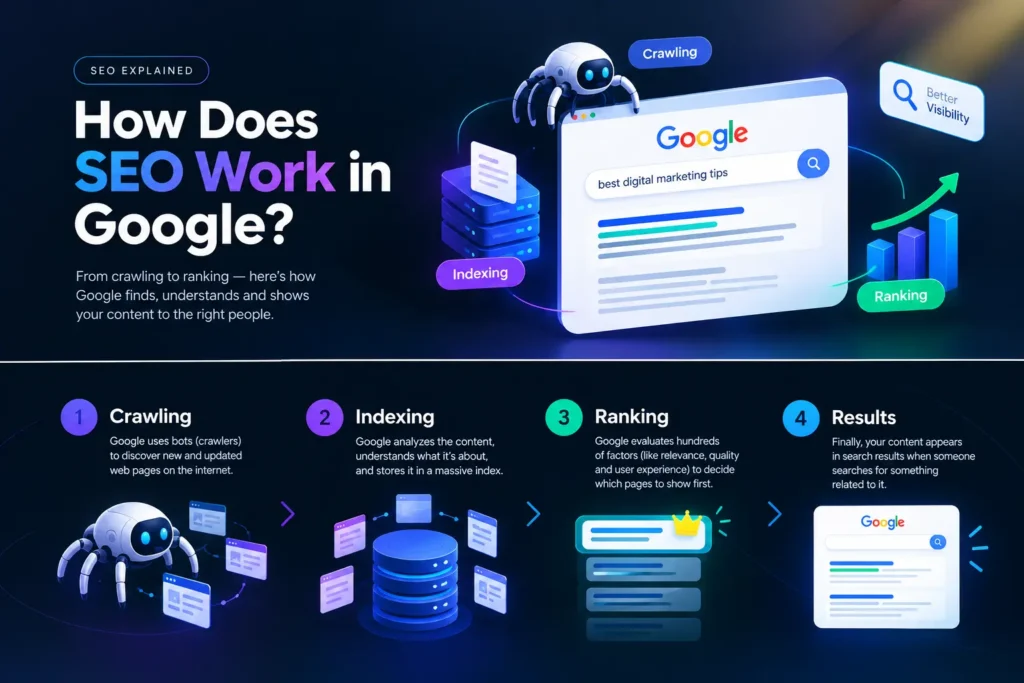
Here’s the short answer. SEO works by making it easy for Google to find your page, understand it, and trust it enough to show it for a search. That happens in three stages: crawling, indexing and serving. This guide explains how SEO works in Google in plain language, so you know what to fix first.
How Does SEO Work? The Short Answer
SEO, short for search engine optimization, is the work you do so your pages can appear in Google when people search for something related to your business. Google says it doesn’t accept payment to crawl a site more often or rank it higher. So SEO is about earning your spot, not buying it.
If you’re still asking how SEO works, picture this. Google is a huge library with a very fast librarian, and your website is a book. The librarian has to find the book, read it and file it in the right place. Later, when someone asks a question, the librarian pulls out the books that answer it best. SEO is everything you do to make your book easy to find, easy to read and worth recommending.
So how does SEO work in practice? It comes down to three jobs:
Help Google find your pages.
Help Google understand what each page is about.
Show that your page is a better answer than the others.
How Search Engines Work: Crawling, Indexing and Serving
To understand how SEO works in Google, you first need to know how search engines work. Google describes its search as three stages, and not every page makes it through each one.
google
Crawling: how Google finds your pages
Crawling is discovery. Google uses automated programs, called crawlers, to download text, images and videos from the pages it finds. It finds new pages by following links from pages it already knows, and from sitemaps that site owners submit.
Things can go wrong here. A slow server, network errors, or a robots.txt file that blocks the crawler can all keep Google away from a page.
What to do: link every important page from somewhere else on your site, submit an XML sitemap in Google Search Console, and check that your robots.txt isn’t blocking pages you want found.
Indexing: how Google understands your content
After crawling, Google tries to work out what the page is about. It looks at the text, images, video, title and other details, then stores what it learns in the Google index, which is a very large database. It also checks whether the page duplicates another one and picks a canonical version, the one that may be shown in results.
Here’s the part many beginners miss: indexing isn’t guaranteed. A page can be crawled and still stay out of the index, for example because of a noindex tag, thin content, or a near-copy of another page.
google
Quick check: paste your page address into the URL Inspection tool in Search Console. It tells you if Google has indexed the page or not.
Serving: how Google picks what to show
When someone searches, Google looks through its index and returns what it judges most relevant. The results page changes with the query. A search like “bicycle repair shops” is likely to show local results, while “modern bicycle” is more likely to bring up images. Location, language and device also change what you see.
This last stage is where ranking happens, and it’s where most SEO effort goes. Crawling and indexing get your page into the race. Serving decides whether it wins.
How Does SEO Work for Rankings? The Google Ranking Factors That Matter
This is the part most people really mean when they ask how does SEO work: why one page sits at number one and another sits on page five.
Google doesn’t publish a full list of Google ranking factors, and anyone selling you “the exact formula” is guessing. Still, a few signals are well documented and worth your time.
Relevance. Does your page match what the person meant, not only the words they typed? Someone searching “how does SEO work” wants an explanation. A page that tries to sell them a service in the first line will lose to one that explains.
Content quality. Google’s guidance favours helpful, people-first content that shows experience, expertise, authority and trust (often shortened to E-E-A-T). Real examples, clear steps and honest limits beat generic text every time.
Backlinks. A link from another trusted site works like a recommendation. One link from a relevant local website is worth more than fifty from random directories.
Page experience. Pages should load fast, work well on a phone and use HTTPS. Google mainly uses the mobile version of a page for indexing, so a site that only looks good on desktop is already behind.
Context. Where the searcher is, what language they use and what device they hold all play a part. That’s why two people can search the same words and see different results.
The Three Parts of SEO
Most SEO work falls into one of three buckets. Seeing how SEO works across all three keeps you from over-investing in just one.
Type What it covers Examples
On-page SEO Content and HTML on the page Title tag, headings, intro, image alt text, internal links
Technical SEO Whether Google can crawl and index the site Sitemap, speed, mobile layout, HTTPS, broken links
Off-page SEO Signals from outside your site Backlinks, brand mentions, Google Business Profile
My advice on how SEO works for a new site: fix technical problems first, because nothing else matters if Google can’t reach the page. Then work on on-page SEO, and only then spend time on links. If you serve customers in one town or district, set up your Google Business Profile early. For “near me” searches, it often matters more than your blog.
How to Make SEO Work for Your Website: A Starter Checklist
If you want a simple plan to see how SEO works on your own site, follow these steps in order.
Pick one main keyword for each page. Search it on Google and look at the top results. If they’re all service pages, don’t write a blog post for it.
Place the keyword naturally. Use it in the title, the H1, the first paragraph, one subheading and the URL. Don’t repeat it just to hit a number. Google doesn’t publish an ideal keyword density, so write for the reader first.
Answer the question early. Give the answer in the first few lines, then add depth.
Add internal links. Link related pages together so crawlers and readers can move around easily.
Check speed and mobile layout. Open your site on a normal phone with normal mobile data, not just on office Wi-Fi.
Connect Search Console and submit your sitemap. It’s free and shows how Google sees your site.
Earn links the honest way. Publish something useful, list your business in genuine local directories, and share your work with people who’d care.
Update old pages. A fresh example and a corrected detail can help a slipping page.
Mistakes That Stop SEO From Working
Most beginners get how SEO works wrong in the same few ways.
Stuffing keywords. It reads badly and doesn’t help you rank.
Publishing and forgetting. If you never check whether the page is indexed, you won’t know why traffic is zero.
Copying other sites. Duplicate content gives Google no reason to pick your page.
Ignoring search intent. A great page that answers the wrong question still won’t rank.
Expecting overnight results. More on that below.
[ADD YOUR EXPERIENCE: one real mistake you've seen with a client or your own site, what happened, and how you fixed it.]
How Long Does SEO Take?
Once you know how SEO works, the next question is always timing. Honestly, it depends. Competition, the age of your site, the quality of your content and your technical health all play a part. Google doesn’t promise a ranking timeline, and nobody else should either. For most new pages, expect weeks to months, not days. Treat SEO as steady work, not a switch, because how SEO works over time matters more than any single trick.
FAQs
How does SEO work in Google for beginners?
Google finds your page by crawling, stores it in its index, and then decides where to show it for each search. SEO helps at every step: making the page reachable, making the topic clear, and proving it’s useful.
How does SEO work step by step?
First, make sure Google can crawl the page. Second, make sure it can index it. Third, make the page the best answer for one search. Then watch the results in Search Console and improve.
How do search engines work in simple words?
They discover pages by following links, store what they learn in a large database, and then pick the most relevant pages when someone searches.
Does Google rank pages by keyword density?
No ideal percentage is published. Use your main keyword where it fits naturally and cover the topic fully. Stuffing makes content worse.
Can I do SEO myself?
Yes. The basics of how SEO works in Google, like clear titles, helpful content, a fast site and Search Console, are all learnable. Hire help when you’re stuck on technical issues or tough competition.
Is SEO free?
The clicks from organic results don’t cost per click, but SEO still takes time, effort and sometimes paid tools.
Your Next Step
Open Google Search Console today and inspect your most important page. If it isn’t indexed, fix that first. If it is, look at the keyword you want it to rank for and ask one honest question: does this page answer it better than the top three results? That’s how SEO works in Google, one page at a time.
Want help checking your own site? [ADD YOUR CTA: WhatsApp / contact link]
On-page package
Internal links (add at least 1):
Anchor “on-page SEO checklist” → your on-page SEO service or blog page.
Anchor “Google Business Profile” → your local SEO page.
Anchor “Search Console” → a beginner’s tutorial, if you have one.
External reference (verified in search): Google Search Central, “In-depth guide to how Google Search works”: https://developers.google.com/search/docs/fundamentals/how-search-works
Image plan:
Placement Image prompt Alt text
After intro Clean flat illustration of a magnifying glass over a webpage with a Google-style search bar, blue and white how does SEO work in Google
Crawling, indexing, serving section Simple 3-step flow diagram: crawl, index, serve, with icons how search engines work: crawling, indexing and serving
Three parts of SEO Three-column infographic: on-page, technical, off-page on-page, technical and off-page SEO explained
Checklist Checklist graphic with 8 ticked items SEO checklist to make SEO work for your website
Video ideas: Embed Google Search Central’s “How Search works” video if it’s still live (check before publishing), or record a 2-minute screen share of URL Inspection in Search Console.
Schema: Article plus FAQPage, because the post has a real FAQ section and informational intent.
Self-check
Word count: about 1,650 words.
Keyword density: “how does SEO work” and the close variant “how SEO works” appear 20 times, roughly 1.2% density.
Placeholders for you: one real client or personal mistake, and your CTA link. I didn’t invent any experience, so the E-E-A-T section needs your real example.
Before publishing: run Copyscape or Grammarly, and confirm the Google link and any embedded video still work.
I skipped the expert interview and the 30-topic list since you wanted the article directly. If you’d like a Manglish version, a content calendar of related topics, or a .docx file, tell me and I’ll do it.