What Is SEO? A Beginner's Guide
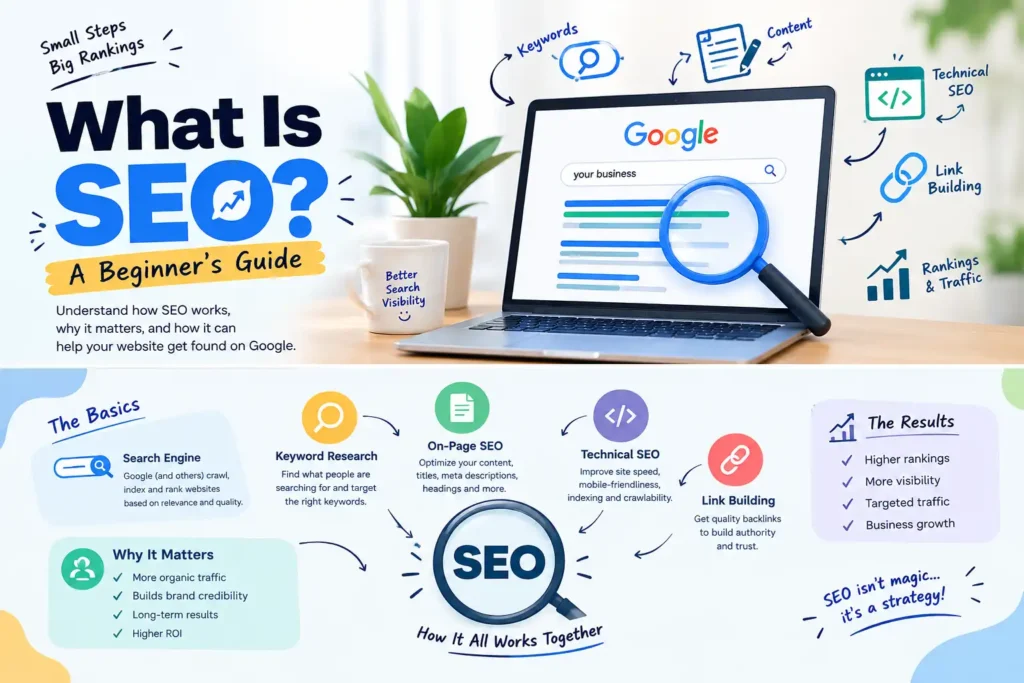
What Is SEO? A Beginner's Guide
You type your own business name into Google and find nothing on the first page. Worse, a competitor with an older, uglier website sits right at the top. If that has happened to you, you are probably wondering what is SEO and whether it can fix this.
Short answer: yes, it can help, though not overnight. This guide answers one question, what is SEO, and then walks through how it works and the first steps you can take this week. No jargon, no tricks.
What Is SEO? The Short Answer
SEO stands for search engine optimization. It means improving your website so search engines like Google can find it, understand it and show it to people who are searching for what you offer. Google's own documentation describes Search Engine Optimization as the process of making your site better for search engines.
The word to remember is "organic". When a visitor comes to you through SEO, you did not pay for that click. Someone searched, saw your page in the normal results and chose it.
So what is SEO in one line? It is the work of earning a spot in search results by being the clearest, most trustworthy answer to a question.
What Is SEO in Digital Marketing?
When people ask what is SEO in digital marketing, the honest answer is this: it is the search part of your marketing. Digital marketing covers every way a business reaches customers online, including social media, email, paid ads, content and search. SEO is usually the slowest channel to start and the cheapest one to keep running.
Here is how it compares with paid search ads:
| Factor | SEO | Paid ads |
|---|---|---|
| Cost per click | No direct cost per click | You pay for every click |
| Speed | Takes weeks or months | Can start the same day |
| After you stop | Pages can keep bringing visitors | Traffic stops when the budget stops |
| Best for | Steady, long-term traffic | Offers, events and quick launches |
Most small businesses do best with both. Run ads for something urgent, like a festival sale, and let SEO build steady traffic in the background.
[ADD YOUR EXPERIENCE: one or two sentences on how SEO fitted into a real client's marketing mix, with real numbers if you can share them.]
How SEO Works: Crawl, Index, Rank
Understanding what is SEO means understanding how a search engine picks what to show. It does three jobs, and your page has to pass all of them.
- Crawling. Bots follow links from page to page to discover content. If no link leads to your page, it may never be found.
- Indexing. The search engine reads the page and stores it in a huge database. Blocked or very thin pages can get left out.
- Ranking. When someone searches, the engine picks the indexed pages that best match the question and puts them in order.
Nobody outside Google knows the exact ranking formula, and anyone who claims to is guessing. What we do know is that search engines want to show pages that answer the search quickly, load well on a phone and come from a source people can trust. Build for that and you are on the right track.
Types of SEO You Should Know
A beginner asking what is SEO usually hears about three parts: on-page, off-page and technical. They work together, so it helps to see them side by side.
On-Page SEO
This is everything you control on the page itself: the title, headings, text, images and internal links. Put your main keyword in the title and the first paragraph, use clear headings and write for the person reading, not for a bot. Add short alt text to images so search engines and screen readers know what the picture shows.
Off-Page SEO
This covers signals from outside your website, mainly backlinks, which are links from other sites to yours. A link from a respected site works like a recommendation. You earn them by publishing useful content, listing your business in genuine directories and getting mentioned by real people. Cheap link packages are a bad idea. They can get your site penalised.
Technical SEO
Technical SEO makes sure search engines can reach and read your site without trouble. That means fast pages, a mobile-friendly design, HTTPS, clean URLs and a sitemap. If your site crawls along on a phone with weak mobile data, fix that before you write your fiftieth blog post.
Local SEO
If you serve a specific area, add local SEO on top. Complete your Google Business Profile, keep your name, address and phone number the same everywhere, and ask happy customers for reviews.
Start With Keyword Research
Keywords are the words people type into a search box. Keyword research means finding the phrases your customers really use, then building pages around them. A dentist's patients may search "tooth pain at night" long before they search "dental clinic".
Look at the intent behind each phrase:
- Informational: the person wants to learn, like "what is SEO".
- Commercial: they are comparing options, like "best SEO course".
- Transactional: they are ready to act, like "hire an SEO freelancer".
- Local: they want something close by, like "SEO services near me".
Free tools such as Google Keyword Planner and Google Search Console show what people search for and what already brings you visitors. Pick one main keyword per page and a few related phrases. Do not cram them in. If a sentence sounds odd when you read it aloud, rewrite it.
A Simple SEO Checklist for Beginners
Now that you know what is SEO, do not try everything at once. This SEO for beginners checklist works best in order, one page at a time.
- Choose one main keyword for the page.
- Write a title of about 60 characters that includes it.
- Write a meta description of 150 to 160 characters that makes people want to click.
- Use one H1 and clear H2 headings.
- Answer the main question in the first few paragraphs.
- Add images with short, honest alt text.
- Link to two or three related pages on your own site.
- Check that the page loads fast and looks right on a phone.
- Add your site to Google Search Console and request indexing for new pages.
Common SEO Mistakes
- Keyword stuffing. Repeating the same phrase in every line makes the text hard to read and can hurt you.
- Copying content. Search engines do not reward pages that copy others. Write your own.
- Ignoring mobile. Many people search on their phones, so a clumsy mobile site loses visitors fast.
- Expecting quick wins. Most people who first learn what is SEO hope for results within a week. It rarely works that way.
- Skipping Search Console. It is free and shows errors you would otherwise never see.
[ADD YOUR EXPERIENCE: the most common SEO mistake you see on client websites, and what changed after you fixed it.]
How Long Does SEO Take?
Once people understand what is SEO, the next question is always about time. It depends on your competition, the age of your site and the quality of your content. Some sites see early movement within a few months, while competitive keywords can take longer. Be careful with anyone who guarantees a number one ranking. Nobody can promise that, because the search engine makes that call, not the agency.
Track progress in Google Search Console. Watch impressions, clicks and average position for the pages you worked on. Rising impressions are usually the first good sign.
Free Tools to Start With
- Google Search Console: shows how your site performs in search and flags errors.
- Google Analytics: shows what visitors do after they arrive.
- Google Keyword Planner: gives keyword ideas and rough search demand.
- PageSpeed Insights: tests how fast a page loads on mobile and desktop.
Frequently Asked Questions About What Is SEO
What is SEO in simple words?
It is the practice of making your website easy for search engines to find and useful for people, so it shows up when someone searches for what you offer.
What is SEO in digital marketing used for?
It brings free, targeted visitors to your website so you can get enquiries, sales or sign-ups. Over time it also builds trust in your brand.
Is SEO free?
You do not pay search engines for organic rankings. But SEO still costs time, or money if you hire someone, for content, fixes and tools.
What is the difference between SEO and SEM?
SEO earns unpaid results. SEM usually means paid search ads, although some people use the term for both together.
Can I learn SEO on my own?
Yes. Google's documentation, Search Console and a small practice website are enough to begin. Test changes on your own site and watch what happens.
Hi, this is a comment.
To get started with moderating, editing, and deleting comments, please visit the Comments screen in the dashboard.
Commenter avatars come from Gravatar.